Report Finds Trump-Class Warships Drive US Navy Costs Up by Billions
By Noor Morgan ·
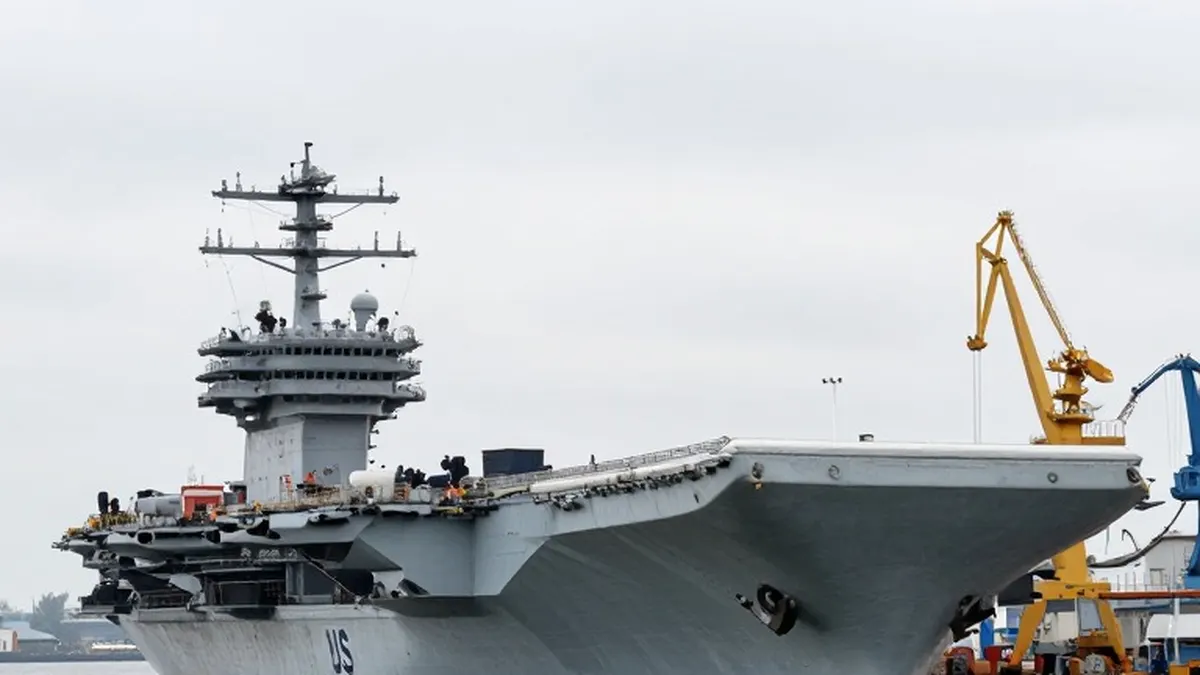
The United States Navy’s commitment to constructing a new class of battleships has resulted in billions of dollars in additional costs, according to a recent report delivered to Congress. This financial surprise emerges as the acting Secretary of the Navy acknowledged that the ongoing conflict with Iran is placing significant strain on the fleet’s operational capacity.
The Congressional Budget Office analyzed the Navy’s 2027 shipbuilding plan and found that projections were too optimistic. The report notes that certain ship designs proved more complex than anticipated, leading to higher expenses than originally calculated. Total shipbuilding costs are now expected to average 54 billion dollars annually in 2026 terms over the next three decades. This figure represents an 18 percent increase over the Navy’s initial estimates.
A major factor in the rising costs is the decision to purchase 15 large, heavily armed vessels known as the Trump-class warships. The President has claimed these ships will be 100 times more powerful than previous US warships and will inspire fear in adversaries. However, critics argue that concentrating firepower in a few large ships contradicts the Navy’s stated goal of distributing capability across a larger number of platforms. In response to these concerns, Senate appropriators proposed cutting the 1 billion dollar request for advanced procurement of these ships to zero for the current fiscal year.
Operational challenges have become evident as the Navy works to expand its fleet from 286 to 381 ships over the next 30 years. The return of the USS George Washington to the Pacific in November ended a rare three-month period when no US aircraft carrier was present in the region. Deployments have frequently exceeded 300 days, forcing the Navy to defer maintenance and repairs to keep vessels at sea longer.
Acting Secretary Hung Cao testified before the Senate that the Iran war is a strain on the Navy. He noted that the cost to insure a commercial ship for a single passage through the Strait of Hormuz has surged from 54,000 dollars a year ago to 64 million dollars today. Senator Elissa Slotkin estimated the conflict has cost the US 260 billion dollars, while Senator Richard Blumenthal criticized the fleet’s condition, stating it is worse than when the current administration took office.
Shipping traffic through the Strait of Hormuz remains approximately 65 percent below pre-war levels. Since the conflict began in February, US Navy ships have been deployed for 10 to 11 months, far exceeding the standard seven-month rotation. The USS Abraham Lincoln recently spent 265 days at sea, the longest duration without a port visit for a Navy ship. Cao dismissed reports of food shortages and mental health issues on board, attributing some complaints to fussiness rather than systemic failure.
Experts warn that this overstretch is critical but manageable for now. Professor Kevin Rowlands of the Royal United Services Institute explained that naval planners rely on a rule of threes, requiring three ships to keep one permanently deployed. When a new crisis like the Iran conflict arises, it disrupts this balance, affecting maintenance and personnel readiness across the fleet.
While the US has long enjoyed naval supremacy, China is rapidly closing the gap. US intelligence estimates that China’s shipbuilding capacity is roughly 232 times greater than that of the US. Chinese yards delivered more than twice the naval tonnage of US yards in 2024 and 2025. As the US attempts to manage commitments in the Indo-Pacific, Europe, and the Middle East, it operates with zero spare capacity, making every new challenge a potential source of strain.
Allies in the Pacific and Europe continue to request US naval presence in their regions. However, the US is increasingly seeking burden sharing, turning naval power projection into a diplomatic negotiation. The combination of rising costs, extended deployments, and emerging competitors suggests that the US Navy is operating at its limits, with little room for error in the near future.