Waymo faces scrutiny over Chinese-built robotaxis
A former federal safety adviser argues that the Ojai vans require an independent government audit to rule out hidden surveillance hardware.
By Noor Morgan ·
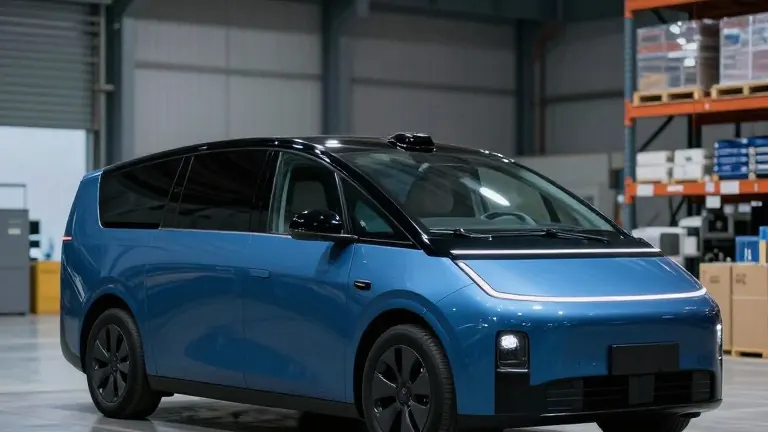
A blue van sits in a Mesa warehouse.
The vehicle is a Waymo Ojai, a model that is set to join the Arizona robotaxi fleet this year.
Missy Cummings, an autonomous vehicle researcher at George Mason University, believes the new cars present a national security risk.
Cummings previously served as a senior safety adviser at the National Highway Traffic Safety Administration.
She stated on the Generation AI podcast that the vehicles are inherent spying devices.
Her concern centers on the fact that the Ojai vans are manufactured in China by the automaker Zeekr.
This differs from Waymo’s previous fleet of Jaguar SUVs, which are built in Austria.
Waymo says the Ojai vehicles arrive in the United States without connected-car technology.
The company then installs its own cameras, sensors, and self-driving systems at its Mesa facility.
Cummings argues that these assurances are not sufficient to guarantee the vehicles are secure.
She called for an independent third party, likely a government agency, to inspect the cars for hidden surveillance technology.
She also wants auditors to look for security vulnerabilities that foreign adversaries could exploit. "I think that we need an independent third party, probably a government agency, to go in and take a look and see if that is indeed true," she said. The potential scale of the issue is growing rapidly. Research firm MoffettNathanson estimates Waymo will import about 5,000 Ojai vehicles this year. That number exceeds the size of the company’s existing fleet. Lawmakers have responded to the situation with legislation. A bipartisan bill from Sens. Bernie Moreno, R-Ohio, and Elissa Slotkin, D-Mich., would ban vehicles built in China. This ban would apply even when the self-driving systems are American. The Connected Vehicle Security Act of 2026 cleared the Senate Commerce Committee unanimously in July. Cummings explained how the spying could theoretically happen. Robotaxis continuously collect information through cameras and other sensors. This data could reveal sensitive details about passengers or secure government sites, such as military bases. Vehicles traveling near military installations might collect information about traffic patterns or the movement of personnel. She also acknowledged the possibility that someone could remotely compromise an autonomous vehicle and take control of it. She considers that risk relatively small compared with the risks of foreign surveillance or privacy intrusions. She questioned whether installing Waymo’s own technology eliminates potential vulnerabilities. Even if the shell of the car is Chinese, different technologies can be layered in, She noted that U.S. investigators discovered cellular modems hidden inside Chinese-built cranes at American ports in 2024. The Coast Guard warned that the devices could provide a way to disrupt operations remotely. Investigators did not establish that the modems had been used for espionage. Cummings stopped short of endorsing an outright ban on the vehicles. She said she is not generally a big fan of bans because she thinks you can throw the baby out with the bathwater. She acknowledged that some of the movement behind the bill is motivated by economic interests as well as national security. Even with steep tariffs on Chinese exports, some analysts estimate that a completed Ojai costs Waymo approximately $100,000. That is roughly half the cost of its Jaguar vehicles, which are priced at about $200,000. She said some support for a ban comes from a strong lobby in America to keep Chinese vehicles out and promote the American automotive sector. Rather than imposing a blanket prohibition, she favors stronger technical oversight. She believes U.S. regulators lack the technical capacity to inspect advanced AI systems. She noted that federal agencies that could do the work are understaffed and underfunded. Her proposal is to hand the job to federally funded research and development centers, such as MIT Lincoln Laboratory. She said these centers have security expertise and the right people who are independent of both industry and the government. For passengers, Cummings said the larger privacy issue extends well beyond Chinese manufacturing. She advised robotaxi passengers that they should never talk about anything that they would not be willing to see on the Internet.
Source: KTVK