Pagosa Springs Faces Record River Levels as Southwest Evacuations Expand
Officials in Colorado and Arizona issued mandatory evacuations on Sunday as the San Juan River approached historic crests and flash floods trapped residents in homes.
By Marek Collins ·
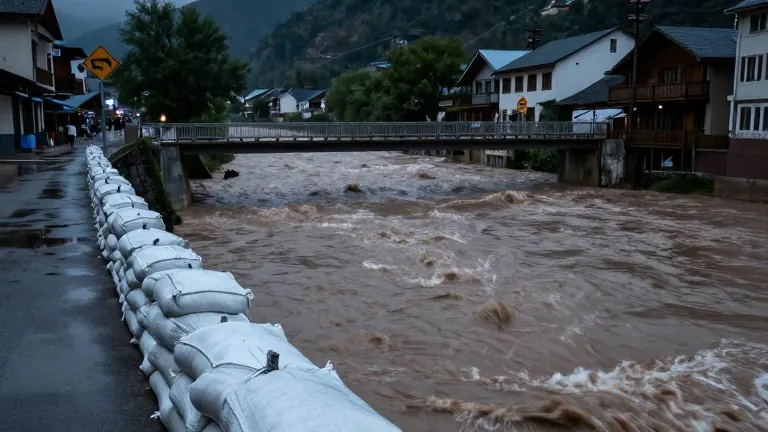
Officials in Pagosa Springs, Colorado, warned on Sunday that the San Juan River could crest at 21.9 feet, a level that exceeds the 17.8-foot peak recorded during the devastating 1911 flood. The Archuleta County Sheriff's Office described the event as potentially catastrophic, noting that the town of more than 2,000 residents near ski resorts is bracing for historic water levels.
By sundown on Sunday, the river had already risen to 14 feet. Vicky Schaffer, a spokesperson for the county, confirmed that roads in and out of the town were closed. Residents who were not under mandatory evacuation orders were urged to stay home. The highway entering the town was closed to inbound traffic, and officials advised residents to avoid contact with the San Juan River after sewage was discharged into the water.
The current storm system is part of a broader pattern of heavy rainfall affecting the Four Corners region. On Sunday afternoon, the San Juan County Office of Emergency Management in New Mexico issued evacuation alerts for anyone within a half-mile of the Animas, La Plata, and San Juan rivers. The office posted on social media that the San Juan River was expected to rise overnight and instructed residents to move to higher ground.
This is the second major evacuation order for Pagosa Springs in recent days. Town officials had lifted an evacuation order from flooding the previous week only to reimpose it on Saturday night. Katie German, owner of Bruin Coffee in Pagosa Springs, reported that downtown had been evacuated and street flooding was present. She expressed concern that the single bridge into town might wash out, preventing trucks carrying food and fuel from entering the community.
Meanwhile, communities in Arizona issued their own mandatory evacuations. In Sedona, officials ordered residents near Oak Creek to leave immediately as floodwaters rose. Multiple people were trapped in their homes, requiring helicopter rescues. Michelle Grimm, a longtime Sedona resident, said she had never seen neighborhoods completely submerged or helicopters rescuing people from residential areas. She noted that water levels were expected to peak by Sunday evening.
In Gisela, a small community along Tonto Creek in Gila County, officials ordered a total evacuation for several hundred residents. Tucson, located 230 miles south of Sedona, experienced flash floods, river flooding, and swift boat rescues. Aaron Hardin, a meteorologist with the National Weather Service in Tucson, stated that the region is receiving two or three months of rain in a span of a couple of days.
The National Weather Service issued flood warnings and watches for nearly all of Arizona, parts of southern Utah, southwestern Colorado, western New Mexico, and part of southern Nevada. Forecasters estimated that up to 4 inches of rain could fall across the region, fueled by a series of Pacific storm systems. In Flagstaff, rain fell nearly nonstop on Sunday, flooding local roads and overwhelming storm drains. Volunteers at Our Lady of Guadalupe Church filled plastic bags with sand to prevent further water entry into the building.
New Mexico Governor Michelle Lujan Grisham urged the federal government on Thursday to authorize additional assistance for communities recovering from widespread flooding. She stated that the current presidential disaster declaration lacks funding from FEMA's public assistance program, which reimburses local and tribal governments for up to 75% of debris cleanup and emergency protection costs. The governor's office said New Mexico is currently covering these costs while it presses its case to Washington.
At least 10,000 homes remained underwater in San Juan County following the initial flooding that began on October 22. Disaster officials reported that water levels were so high that some flood gauges broke, with levels exceeding records set more than a century ago. The federal assistance declaration covers four counties and four pueblos, including the Laguna, Jicarilla Apache, Zia, and San Ildefonso Pueblos.
State air rescue crews in Arizona are assisting with rooftop evacuations, and transportation crews are clearing debris. Brian Hurley, a senior meteorologist with the weather service in Maryland, described the system as vigorous with a lot of moisture. The rain is expected to taper off across Arizona as the wet weather moves eastward into other parts of the country.
Source: KUNM