Moon Water Reserves Support Towns, Not Cities
Harvard and Durham researchers found lunar water supplies limit sustainable settlement size to 10,000 residents.
By Noor Morgan ·
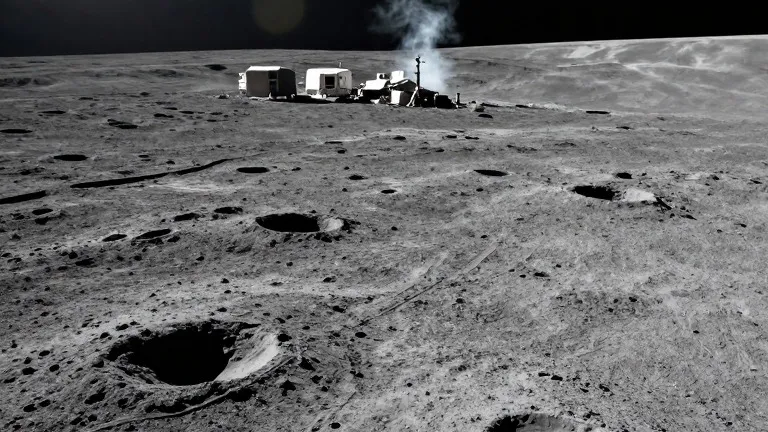
A new study limits the size of future moon settlements to roughly 10,000 people based on available water reserves.
Researchers from Harvard University and Durham University published their findings in Frontiers in Space Technologies this week. The analysis responds to recent public claims by major space companies regarding the speed and scale of lunar colonization.
SpaceX CEO Elon Musk stated in February that the company is prioritizing a self-growing moon city over Mars, aiming for completion in under ten years. Blue Origin CEO Jeff Bezos has predicted millions of people will live in space by 2045. Martin Elvis, a senior astrophysicist at the Smithsonian Astrophysical Observatory, and Jonathan McDowell, an honorary professor at Durham University, tested these projections against physical constraints.
The team determined that generating power for one million residents is feasible using solar and nuclear sources. Water availability creates the bottleneck. Current estimates place lunar water reserves at approximately one billion tonnes, mostly located in permanently shadowed polar regions.
Under optimal conditions, including recycling 98 percent of water like the International Space Station, one million residents could survive for about 100 years. A settlement of 10,000 people would last for centuries. Elvis compared the total water supply to a small lake, noting it cannot support a large city for long.
The researchers consider their starting estimate generous. Elvis believes the one billion tonne figure is likely 20 or 30 times too high. He estimates only one percent of the original amount is reliably recoverable. If his lower estimate holds true, the 100-year supply for a million people shrinks to one year.
Gordon Osinski, a planetary geology professor at Western University, cautioned that satellite measurements remain uncertain. He suggested the water may resemble Arctic permafrost, consisting of sub-millimetre ice crystals mixed into soil. McDowell noted that the findings clarify engineering needs rather than discouraging development.
Source: CBC News