Vance Uses Midterm Rallies to Test Populist Pitch for 2028
In speeches across four states, the vice president blends nostalgic economic tales with cultural critiques while managing the fallout of the Iran conflict.
By Noor Morgan ·
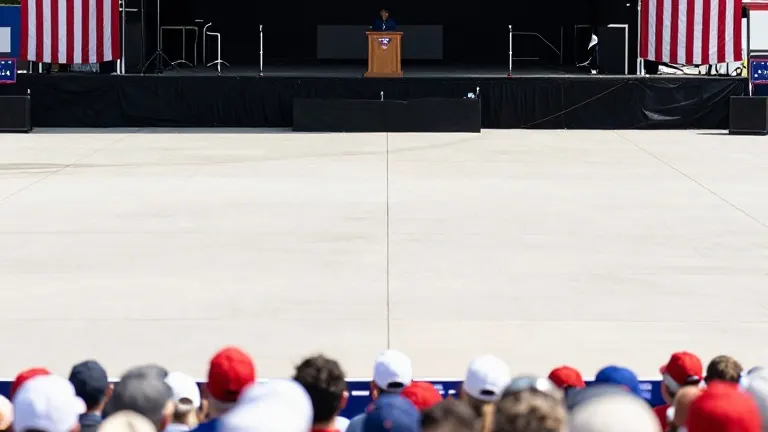
Vice President JD Vance spent the afternoon of Thursday in Weatherford, Texas, trading jabs with Democratic Senate candidate James Talarico before a cheering crowd. Vance mocked Talarico’s recent comments on grappling with his masculinity and whiteness, telling the audience that there was not much to grapple with. The performance marked a distinct shift from his usual demeanor, favoring the rhythm of a practiced politician over the comedic flair often seen in his campaign events.
This speech came the same day President Donald Trump addressed a rally in Rock Hill, South Carolina, as part of a pre-midterm tour. Vance’s delivery in Texas contained familiar Republican elements, including promises of restored greatness and sharp attacks on opponents. Observers note that these appearances offer a preview of how a Vance presidential bid might unfold once the 2028 campaigns begin in earnest next year.
In North Carolina earlier in the week, Vance invoked the national unity felt after the September 11, 2001 attacks. He connected that memory to his own childhood, describing how local small businesses once sponsored his youth football teams. Speaking in Howell, Michigan, Vance said he remembers looking at old jerseys and finding that the sponsors no longer exist. He blamed politicians in distant cities who ignored the needs of states like Michigan and Ohio, forcing local communities to pay the consequences.
Vance frames this narrative as a return to a traditional American ideal disrupted by Washington elites. He emphasizes a story of racial harmony from his youth, noting that children from working-class Black and white families played together without concern for skin color or privilege. This message mirrors the anti-establishment themes of the Trump era but is delivered with a more measured tone. However, Vance occasionally breaks from that polish, telling the Texas crowd he was sweating at the podium and using casual language to connect with voters.
A major difficulty for Vance is promoting Republican candidates while serving an unpopular president. The impact is visible in discussions about energy costs. Vance avoids mentioning the Iran War, which caused gas and diesel prices to rise. Instead, he frames high prices as a recurring geopolitical issue. Telling a crowd in Montana, he noted that gas prices spiked in 2022, 1979, 2001, and 2007 whenever a dictator caused instability. He argued that current prices are lower than they were in 2022.
Vance also addresses the high cost of beef by pointing to consolidation among meatpackers. This approach allows him to acknowledge consumer pain while sidestepping the fact that some of Trump’s policies have angered beef producers. The strategy balances economic empathy with political protection for the White House.
Between campaign stops, Vance serves as the head of the president’s anti-fraud task force. This role provides him with administrative experience and a platform to share his personal history. In Cincinnati last week, he reminded the crowd that he worked as a cashier at Dhillon Foods, a grocery store about 20 miles from the venue. He added that many of his family members relied on federal food benefit programs.
Vance’s background as a former memoirist about poor rural Ohio gives him specific biographical tools that Trump lacks. He can speak directly about military service and economic hardship. Yet, the challenge for any Republican successor is to replicate the energy that has kept Trump’s base engaged for over a decade.
Source: KIOS-FM