Trump's $5,000 'Dividend' Faces Skepticism as Election Day Arrives
The president's promise to pay every adult if Republicans hold Congress is drawing bipartisan questions about funding and legality.
By Marek Collins ·

President Donald Trump has promised to send $5,000 to every adult U.S. citizen if the Republican Party retains control of both chambers of Congress in Tuesday's midterm elections. The pledge, which the president has termed the 'Trump Dividend,' was made during his keynote address at the Republican National Committee midterm convention in Dallas last week. Trump told the crowd that the payment was a reward for voters who helped secure economic success, stating, 'If the Republicans win, you win with us and you get $5,000.'
The proposal has immediate implications for the current election, where Democrats need to gain a net three House seats and four Senate seats to take control of Congress. With polls open and voters heading to the polls across all 50 states, the promise adds a financial incentive to the political debate. Trump argued that the nation's economy is strong enough to handle the expense, claiming the United States is taking in record amounts of money from tariffs and trade. He told reporters before boarding Air Force One in Ireland that the payment was going to happen '100%.'
However, the path to delivering the checks is not straightforward. House Speaker Mike Johnson, a Republican from Louisiana, acknowledged on Sunday that the proposal requires congressional approval. 'I would assume, yes, he'd need Congress to act, and that's a creative idea,' Johnson said. He pledged to work with the administration to find consensus, despite the slim Republican majority in the House. This admission contrasts with Trump's earlier comments to CBS News Texas, where he suggested Congress might not need to authorize the payments, though he did not specify how the administration could spend over $1 trillion without legislative action.
Bipartisan criticism has emerged regarding the feasibility of the plan. PolitiFact, a fact-checking organization, noted that the biggest payment is far from certain. The analysis pointed out that while Trump cited tariff revenues as a potential funding source, lawmakers did not include a separate tariff dividend in the One Big Beautiful Bill Act tax and spending law passed in 2025. Political analysts indicate that the legislation required to fund such a payout would likely need a 60-vote supermajority in the Senate, a threshold that is difficult to reach in the current political climate. Senator Bernie Moreno of Ohio has said he will introduce legislation to fund the proposal, but the odds of passage remain uncertain.
Economic experts have also raised concerns about the cost. The U.S. Census Bureau estimates there are approximately 245 million U.S. citizen adults, meaning the total cost of the dividend would be around $1.2 trillion. This sum would significantly impact the national debt and could exacerbate existing inflation concerns. Kenneth Rogoff, a former chief economist at the International Monetary Fund, stated that the U.S. is already running an unsustainable deficit and that the dividend would increase the odds of a debt crisis in the coming years. The Associated Press reported that consumer sentiment remains weak, with many voters blaming high prices and the war with Iran for rising costs.
The promise has also sparked debate over whether it constitutes an attempt to buy votes. Election law expert Rick Hasen, a professor at UCLA, wrote that while it is unusual, the promise is likely legal under the First Amendment. He compared the move to other campaign promises, such as tax cuts or new social programs, noting that politicians frequently make such pledges to voters. Richard Painter, a government ethics expert at the University of Minnesota, agreed, drawing a parallel to the 1972 campaign of George McGovern, who promised to give every American $1,000 a year. Both experts noted that while the promise is protected, its fulfillment depends entirely on the legislative process after the election.
The White House has defended the plan by pointing to the administration's economic record. White House spokesperson Davis Ingle stated in a statement that President Trump has consistently proven his doubters wrong, contrasting the current administration with the Democrats' record of inflation and high interest rates. Vice President JD Vance told Fox News that some of the money for the dividend could come from tariff revenue, targeting the American middle class and workers. However, the administration has not released a formal plan detailing how the checks would be distributed or when they would be issued, leaving many voters with questions about the logistics.
The 'Trump Dividend' is part of a broader series of financial promises made by the administration. In 2025, Trump and Elon Musk endorsed a 'DOGE dividend' based on savings from the Department of Government Efficiency, which never materialized. Last November, Trump promised $2,000 tariff dividend checks, which also did not go out. In early 2026, military service members received a 'warrior dividend' of $1,776. This history of unfulfilled financial promises has led some fiscal experts to question the new pledge. Erica York, a senior economist at the Tax Foundation, described the new $5,000 check as 'not gonna happen' due to the limited revenue projected from the current tariff structure.
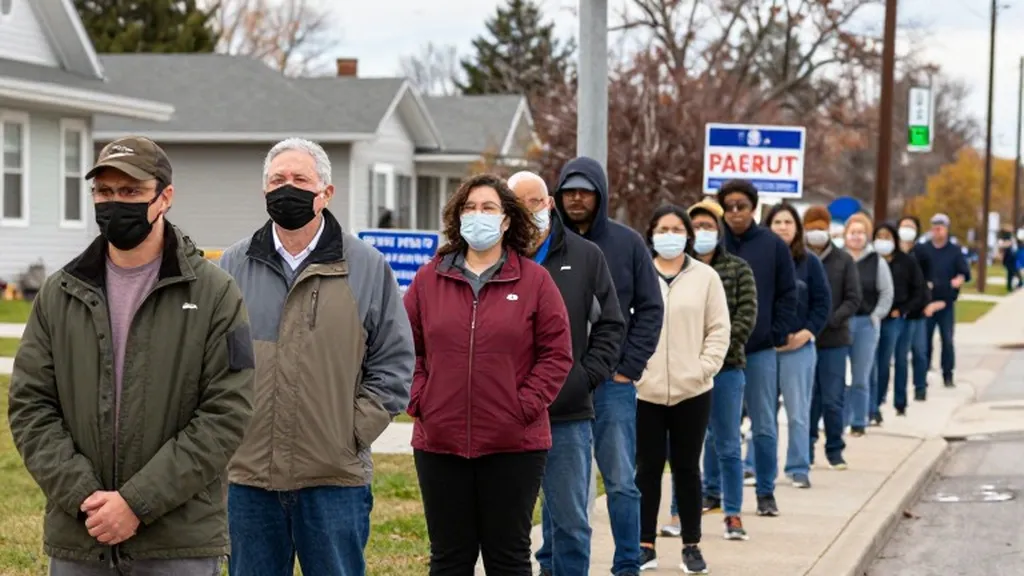
As voters cast their ballots today, the issue of the dividend will likely factor into their decisions. The Associated Press noted that the election is being viewed as a referendum on Trump's second term, with voters struggling with high prices and an unpopular war in Iran. The cost of living, health care, and the administration's handling of the economy are central issues for both parties. Democrats are urging voters to focus on the deficit and the need for oversight, while Republicans are highlighting their legislative record and the promise of continued economic growth under Trump's leadership.