Democrats need three House seats to reclaim control amid redistricting
Voters in 46 battleground districts face new maps in seven states as the race for the 218-seat threshold enters its final hours.
By Noor Morgan ·
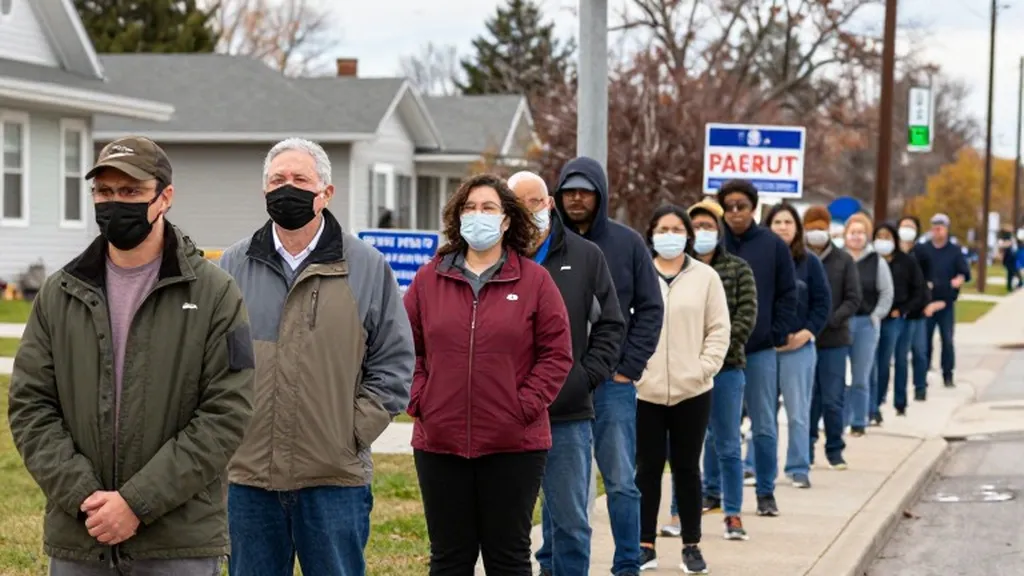
Voters across the United States are casting ballots in a midterm election that will determine which party controls the House of Representatives for the final two years of President Donald Trump's second term. All 435 seats in the lower chamber are on the ballot, setting the stage for a decisive contest over the legislative agenda. The Associated Press describes the election as a referendum on the current administration, with many voters expressing frustration over high prices and an unpopular war with Iran. This context frames the intense competition in dozens of closely watched districts where the outcome could shift the balance of power in Washington.
Currently, Republicans hold 218 seats in the House, while Democrats hold 214, with one independent and several vacancies. This narrow margin means the race is effectively a three-seat battle. Democrats need a net gain of three districts to secure a majority, a threshold that places significant pressure on candidates in competitive areas. Conversely, Republicans can afford to lose no more than two seats to maintain their control. The stakes are high because a change in leadership would likely trigger new investigations and possible impeachment proceedings, according to House Democratic Leader Hakeem Jeffries, who would become the first Black speaker if his party wins.
The geography of this race is defined by 46 battleground districts identified by Ballotpedia. Of these, 25 are currently held by Democrats and 21 by Republicans. The competitive nature of these seats is underscored by recent presidential voting patterns. Twenty-one districts held by Democrats voted for President Trump in 2024, while nine districts held by Republicans voted for Kamala Harris. These numbers highlight the shifting political landscape in which incumbents from both parties face significant challenges from challengers who are capitalizing on local economic concerns and national dissatisfaction.
Redistricting plays a critical role in this year's House race, as seven states are using new congressional maps. These states include California, Florida, Missouri, North Carolina, Tennessee, Texas, and Ohio. The new maps were drawn following mid-decade redistricting efforts and may alter the voting dynamics in these regions. While Republicans attempted to use redistricting to beat the traditional midterm pattern where a president's party loses seats, analysts note that the new districts in Florida and elsewhere may not vote as originally predicted. This uncertainty adds a layer of complexity to the counting process and the final determination of which candidates secure their seats.
Financial resources have shaped the campaign landscape in a significant way. The 2026 elections are likely to be the most expensive in history, according to the Associated Press. Republican committees have outraised and outspent their Democratic counterparts, aided by Trump-affiliated groups and support from Elon Musk. At the candidate level, however, Democrats have outraised their Republican opponents. An analysis of AdImpact data by the Associated Press reveals that 88.1% of Republican general election TV ad spending went to states and districts that President Trump won in 2024. This includes more than $850 million spent in areas where he won by 10 points or more, indicating a heavy investment in defending Republican-held territory.
Voters are weighing their decisions against the backdrop of economic strain and political conflict. A federal judge temporarily barred the Trump administration from implementing a plan intended to prevent noncitizen voting, a move that critics argue risks disenfranchising eligible voters. Additionally, a judge ordered the administration to stop demanding that California election officials segregate ballots cast by people on lists of suspected noncitizens. These legal actions have raised concerns about interference and intimidation, particularly as the Justice Department threatens to prosecute local election officials. The U.S. Postal Service has added hours and staff to ensure that mail ballots are counted on time, a crucial step in a year with high early vote participation.
The mood among Democrats is described as cautiously optimistic, while Republicans are bracing for the possibility of losing the House. The Associated Press notes that one or two seats could tip the balance in either chamber. Many Republican candidates have kept their distance from President Trump, who has continued to make claims about voting fraud and has held dozens of rallies to support his party's candidates. His most recent rally was held in Salina, Kansas, where he urged voters to pretend he was on the ballot. This strategy reflects the broader effort by Republicans to leverage the president's name recognition to protect their seats in a challenging political environment.
Early voting numbers have already surpassed those from four years ago in many closely watched states, with more than 57 million people having voted as of Monday. This surge in participation suggests that turnout will be a decisive factor in the final count. RNC Chairman Joe Gruters stated that everything depends on turnout, asserting that if the party turns out its voters, they will win. In contrast, DCCC Chair Rep. Suzan DelBene emphasized that the American people are angry and want change. These statements capture the competing narratives that have driven the campaign efforts in the final days before the polls close.
The outcome of the House race will also have implications for the 2028 presidential cycle. A strong Democratic performance could boost the profiles of potential candidates such as Gavin Newsom, JB Pritzker, and Pete Buttigieg. It could also complicate the path for Vice President JD Vance, who is seen as a key figure in the Republican party's future. The results will be closely watched by Wall Street, as control of Congress could influence investor concerns about debt ceiling negotiations and spending priorities. The final numbers will determine not only who controls the House but also the direction of the country's legislative agenda for the next two years.